To create parts at the cutting edge of precision detailing, finding water jet services is often the sharpest solution. Here’s a guide to custom water jet cutting, and the benefits it provides.
To continuously produce precision-engineered parts that are often small, intricate or carved from heavy-duty materials, you come to rely on an ingenious method of cutting that offers 100% accuracy, every time. We are talking about CNC water jet cutting technology.
It’s sometimes hard for those outside the industry to understand why finding a custom water jet cutting service is so vital to producing detailed prototypes Or, for consignments of parts needed quickly.
Meanwhile, the team at Custom Moulded Polyurethane get so passionate about the potential of water jet technology, that we welcome a challenge from all sorts of different organisations. Not just those interested in cutting polyurethane, but anyone who wants to use our water jet equipment, CAD capabilities and skills to slice through anything.
So, we decided to bring together some of our insights to create a guide to custom water jet cutting.
What is water jet cutting?
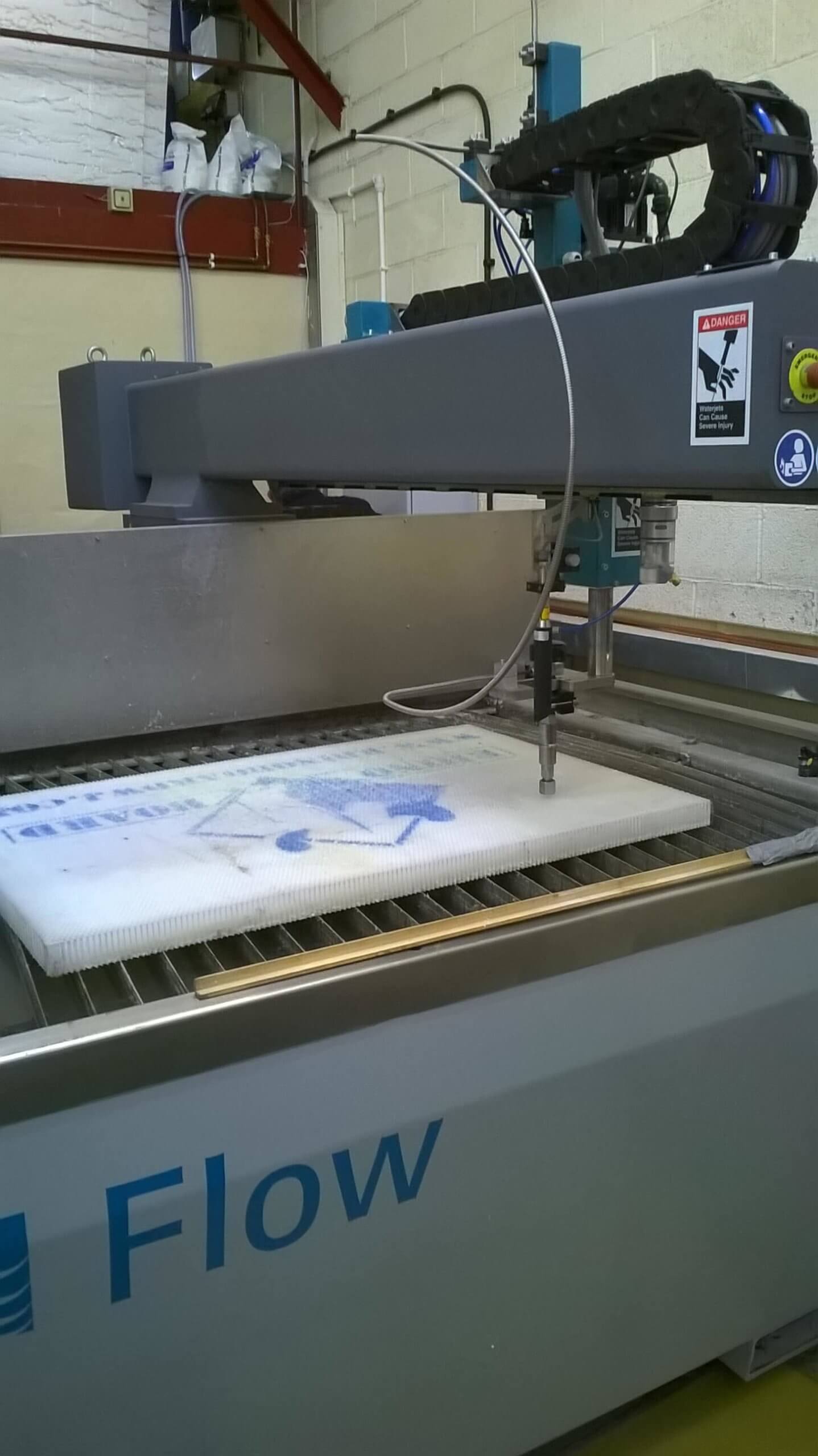
Water under intense pressure, directed through a small nozzle, can slice through any incredible diverse range of materials, from stone to foam as we discuss below.
The ability to control that water stream to a micrometre (1000 times smaller than a millimetre) opens up an infinite world of possibilities. Advanced waterjet equipment can do that.
It’s not just about the power of water to cut precisely though, it can also cut deep.
To show you the difference in capabilities between laser cutting and water jet cutting equipment, lasers create a precise incision on stone and metal to a depth of around 2.5cm. When you use sharp points of water, it can cut the same materials to a depth 10 times greater.
Another important aspect of water jet cutting is its environmental implications. It doesn’t use heat or chemicals to create the perfect finish on a precision-engineered part.
What could be more sustainable than water? It also involves no fumes or allergens.
Lastly, by using water to create prototypes that are perfect in form and function, you can also protect the structure and tensile properties of your materials. For example, cutting through a soft foam or pliable rubber with water jets doesn’t distort it.
One of the reasons water jet cutting is now so common is that it guarantees no burrs, burns, buckling, shredding or flaking. Just the perfect cut to create a smooth edge.
Related article: Our Water Jet Cutting Process Explained
What materials can water jets cut?
You name it, water jets can cut it!
The possibilities include metals and stones; even granite and marble.
As it’s quick and exacting, that high-pressure water jet can also slice through some types of glass, fibreglass and ceramics, without cracking them.
It also swiftly shapes construction foams, rubber and other soft materials, with superb detailing.
The list of things that can be shaped using custom water jet cutting also includes leather, cardboard, cloth and even paper!
How water jet cutting works
The first use of pressurised water as a cutting tool was thought to be during the American Gold Rush in the 1850s.
Nowadays, custom water jet cutting relies on adept use of the software inherent in the most advanced equipment. The direction, depth and detail can be altered to an endless array of possibilities.
Also, the process often uses abrasive materials added to the jet of water. This can be crucial when it’s slicing through thicker, harder substrates. The right mixture creates the correct friction to delicately engrave metal as thin as 0.2 mm too.
The best custom water jet cutting machines also filter the water carefully, before it travels to the pump and inlet check valves. Then, the composition of the water mix can be amended by waterjet technicians, before being put under pressure by the intensifier, and passing through to the cutting heads. The ability to control the intensity of the water stream comes from the accumulator, a device that smooths the pressure.
As you would expect, quality control sensors continuously measure output and abrasive metering.
Related article: What you Need to know about our Industrial Water Jet Cutting
Crafting the perfect part with water jet technology
What this guide to water jet cutting needs to emphasise, is this is not just a highly precise way to create often complex parts. It’s also fast!
Custom Moulded Polyurethane can swiftly deploy its advanced CNC tech to match even a demanding brief. There are no specialist tools or moulds to craft. We can also set up any secondary finishing stages quickly, often facilitating a same-day turnaround in prototyping.
When you commission custom water jet cutting services with us, we can also meet bulk orders for precision-engineered parts to tight deadlines.
Are you ready to dip your toe in, and test water jet cutting? Get in touch and we can quote to cut any material and part, to any degree of complexity.
Want to find out how much it will cost to make your products?